
Salesforce Marketing Cloud Welcome Journey
Connecting subscriber data, email content and purchase-aware journey decisions.
CanDiVino · Data modeling · Journey design · Campaign QA
Documented Salesforce-style prototype — not a live deployment.
01 / The Challenge
Guide new business prospects toward their first paid promotion while preventing irrelevant sends after purchase or consent withdrawal. Entry eligibility, customer data and journey decisions must stay consistent as subscriber status changes.
02 / The Strategy
Separate the master subscriber model from a daily refreshed entry data extension. Admit opted-in prospects with zero orders who signed up within the preceding 24 hours; exclude future dates and prevent re-entry.
Audience: 20 fictional records across four segments, plus two excluded records.
Primary KPI: unique first purchasers / eligible entrants within 30 days.
03 / Campaign Design
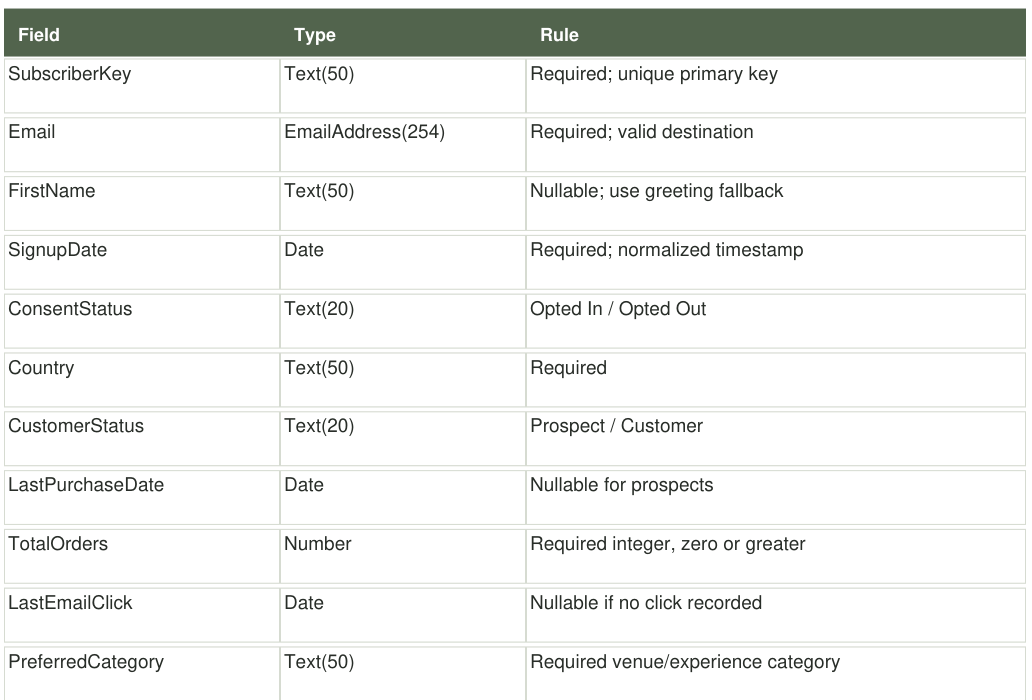
A consistent data foundation. CanDiVino_Master_Subscriber_DE and Welcome_Journey_Entry_DE share 11 fields. SubscriberKey is the unique primary key and maps to subscriber/contact identity. The visual is a design artifact, not a screenshot of a Salesforce account.
Reusable email design. A single-column Content Builder structure combines a shared header, greeting, CTA and footer with diagnostic, guide and offer content. A blank first name falls back to “Hola:”.
Daily intake. Imports add or update by SubscriberKey. Invalid records are logged; missing or incomplete imports pause downstream refresh. Daily intake may introduce almost 24 hours of delay.
04 / The Welcome Journey
DAILY INTAKE
Validate file → Import master data → Segment → Refresh entry DE
↓
ELIGIBLE ENTRY · EMAIL 1
Opted in · Prospect · Zero orders · Signup within 24 hours
↓ Wait 2 days
ENGAGEMENT SPLIT
Diagnostic CTA clicked / not clicked → Email 2 once, on either branch
↓ Wait 3 days
CURRENT PURCHASE CHECK
Purchased → Exit
Zero orders + still eligible → Email 3 → Exit
Unknown or stale purchase data → Hold for review
Before every send: recheck current consent, sendability, exclusions and purchases using current contact data, not only the entry snapshot. Refreshing the entry DE does not remove participants already in the journey.
05 / Project Outcomes
20-record model · 4 segments · 3 emails · Journey logic · QA checklist
The documented package includes a sample dashboard and checks for personalization, consent, mobile rendering, links, entry boundaries, purchase exits and stale-data holds. Segment counts use the 30 September 2026 snapshot.
Synthetic Email 3 example — not live performance:
950 / 962 delivered (98.75%) · 114 / 950 unique clickers (12%) · 38 / 950 first purchasers (4%) · 5 / 950 unsubscribes (0.53%) · 12 / 962 bounces (1.25%).
This illustrative send uses a 7-day attribution window; it does not validate the planned 30-day journey KPI.
06 / What I'd Optimize
Validate purchase events, consent freshness and exits before launch. Then test one subject-line variable, clarify signup expectations and evaluate the landing-page CTA after attribution is reliable.
Release gates: Draft → Marketing review → QA → Client approval → Scheduled. Live platform behavior and client approval remain unvalidated.