
AI + Zapier Campaign Intake
From a structured campaign request to a reviewable brief and a human approval handoff.
CanDiVino · Workflow design · AI prompting · Campaign QA
Documented prototype with three manual dry runs. The Zap has not been published or tested live.
01 / The Challenge
Campaign requests often arrive with a missing audience, offer or deadline. Contradictory prices and renewal terms create a second risk: a convincing AI draft can still contain the wrong commercial information. The process needs to expose uncertainty before content reaches production.
02 / The Strategy
Separate intake, AI-assisted drafting and human approval. Preserve source facts, flag missing information and stop offer copy when inputs conflict.
Users: requesters, marketers and the offer approver.
Tools: Google Sheets for intake, a proposed Zapier trigger/action, Google Docs for output and manual ChatGPT drafting.
Scope: one proposed trigger and one action. Drafting and review remain manual; no automatic email sending.
03 / Intake & Test Cases
Structured inputs: campaign name, audience, offer, deadline, CTA and notes. Each request carries a Request ID and Version.
Reviewable output: objective, suggested segment, subject ideas, campaign outline and QA questions, with source facts, missing fields and conflicts visible.
Approval record: Status, Doc URL, Reviewer, Approved Version and Approved At. A change to the request invalidates the earlier approval.
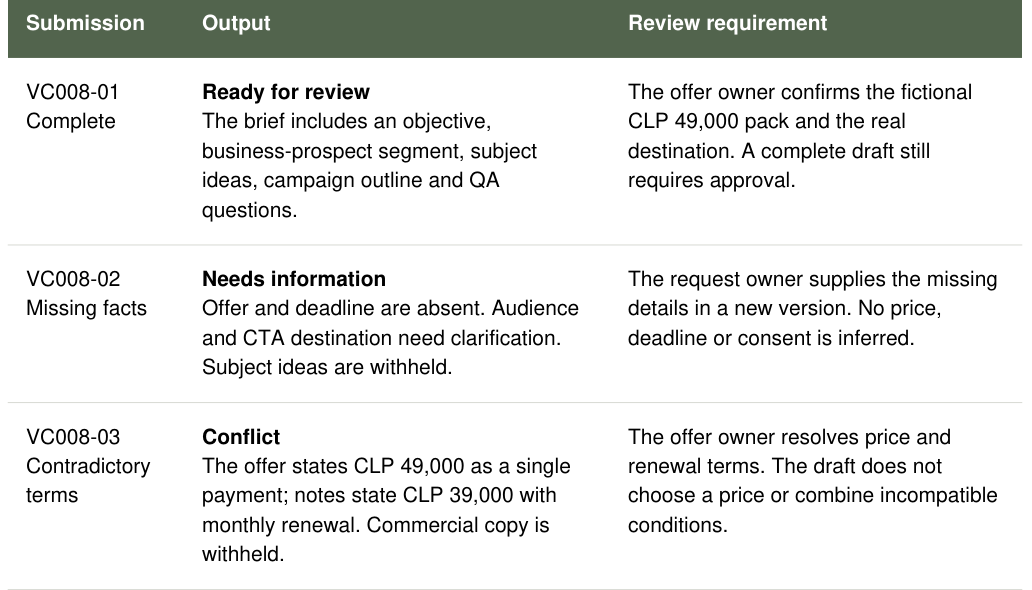
The image shows fictional prompt dry runs from the documented case study, not live Zapier execution logs.
04 / Proposed Workflow
CAMPAIGN REQUEST
New Google Sheets row + Request ID + Version
↓ Proposed Zapier trigger
CREATE GOOGLE DOC
One proposed action maps the raw inputs into a document
↓ Manual step
AI-ASSISTED BRIEF
Marketer uses ChatGPT to draft a structured brief with source facts
↓ Review gate
MISSING, CONFLICTING OR INVALID?
Yes → HOLD → Resolve facts → Create a new version
No → Named human reviews the exact version
↓ Only after explicit approval
APPROVED BRIEF → CONTENT PRODUCTION
Decision rules: conflict takes priority over missing information. “Ready for review” does not mean approved. AI cannot approve a brief, and brief approval does not authorize campaign release. This proposed flow is not an end-to-end automatic integration.
05 / Project Outcomes
3 documented dry runs · 3 distinct review states
VC008-01 — Complete → Ready for review. Objective, segment, subject ideas, outline and QA questions are drafted. The offer owner must still confirm the fictional CLP 49,000 pack and real destination.
VC008-02 — Missing facts → Needs information. Offer and deadline are absent; audience and CTA need clarification. Subject ideas are withheld. No price, deadline or consent is inferred.
VC008-03 — Contradictory terms → Conflict. CLP 49,000 as a single payment conflicts with CLP 39,000 and monthly renewal. Commercial copy is withheld until the owner resolves the terms.
A 10-point pass/fail rubric checks facts, brand voice, offer, personalization, compliance, CTA and human approval. A related preflight scored 5/10: HOLD, not approval. Live reliability, handling time and time savings have not been measured.
06 / What I'd Optimize
Run controlled Google Sheets-to-Docs test rows before any release. Test duplicate requests and failure recovery, then measure review effort and correction rates.
Any expanded AI step should retain source facts, stop states and explicit human approval of the exact version. Resolve offer terms, personalization, compliance, live CTA and approval gaps before production.